
Typical Commercial Electricity Rates UK: 2026 Benchmarks for Businesses
A low unit rate can still leave your business with a poor electricity deal. The phrase “typical commercial electricity rates uk” suggests there’s one clear figure to compare, but your quote also depends on usage, contract terms, site and standing charges.
Two quotes can look similar while covering different costs. Household price-cap figures won’t tell you whether a business electricity quote is competitive, because there’s no Ofgem price cap for business electricity. A headline rate is a useful starting point, not a verdict.
This guide explains what shapes commercial electricity rates in 2026 and how to compare quotes on a like-for-like basis. It covers the bill items to check, why both unit rates and standing charges matter, and what to gather before reviewing or renewing a contract. Have your annual usage, meter details, current contract end date and any extra charges in the quote to hand. That will help you ask clearer questions and make a more informed decision.
Key Takeaways
- Treat typical commercial electricity rates uk as a benchmark, not a guaranteed price. Check when the figure was published and what it includes.
- Look beyond the unit rate. Check standing charges and any other costs shown in the supplier’s quote.
- Compare quotes using the same usage period, meter details and contract length to see how the offers differ.
- Review your operating patterns, site requirements and renewal timing to understand what may affect the rate offered.
- Before deciding, check how supplier commission or any rate uplift is reflected in the contract. A business utility review can help you assess a quote, but it can’t promise a particular saving.
What counts as a typical commercial electricity rate in the UK?
A commercial electricity rate is a charge in a business energy contract, usually expressed as a unit rate for each kilowatt-hour used. It isn’t one guaranteed price for every UK business. A national average can offer context, but it can’t predict an individual business’s bill because usage, site requirements and contract terms differ.
That’s the key to understanding searches for “typical commercial electricity rates uk”. A benchmark is a reference point, not a live supplier quote or a promise that your business can secure the same terms. Before relying on a 2026 figure, check who published it, when it was published, which usage profile it represents and what charges it includes.
Why there is no single rate for every UK business
Suppliers price contracts around the business and the offer available. Annual consumption, when electricity is used, meter setup and contract type can all affect a quote. A small site with modest or uneven demand may receive different unit rates or terms from a high-use site with a different meter arrangement. The unit rate alone won’t show the full difference, so check the standing charge and contract conditions too.
Electricity prices also sit within a wider market. The UK electricity sector overview gives background on how generation, transmission and the market fit together. It explains the wider context, but it won’t tell you what a supplier will quote for your particular site.
What a published rate benchmark can, and can’t, tell you
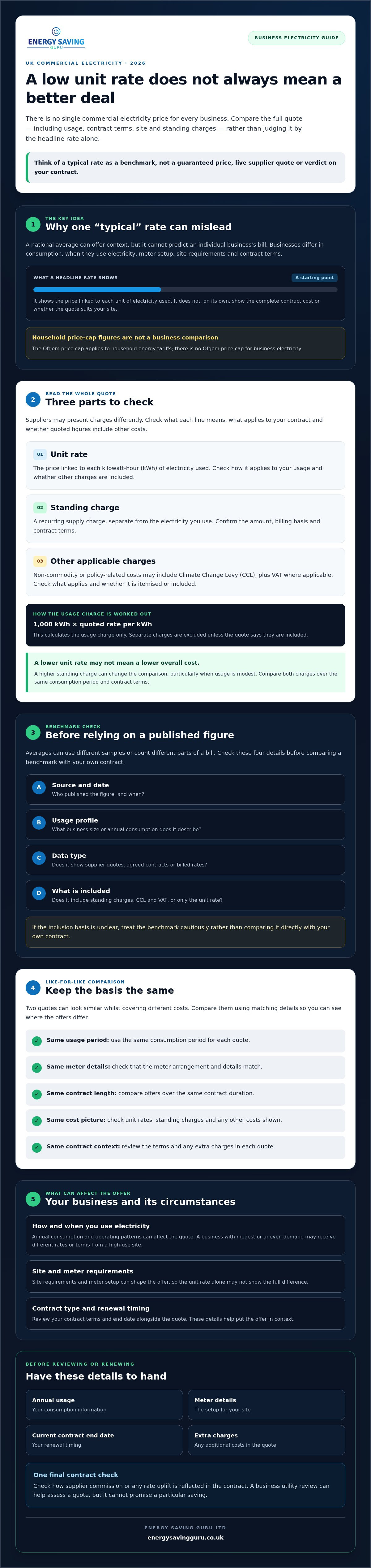
Before relying on a benchmark, check four details:
- Source and date: Who published the figure, and when?
- Usage profile: What business size or annual consumption does it describe?
- Data type: Does it show supplier quotes, agreed contracts or billed rates?
- Inclusions: Does it include standing charges, Climate Change Levy and VAT, or only the unit rate?
These details matter because averages may use different samples or count different parts of a bill. If the inclusion basis isn’t clear, treat the figure cautiously rather than comparing it directly with your own contract.
An average can help you ask better questions, but it can’t prove that an individual contract is competitive. Your bill depends on your own consumption and terms. Household price-cap figures aren’t a substitute: the Ofgem price cap applies to household energy tariffs, not business electricity contracts. Use business-specific evidence, then compare your quote on the same basis. Start by separating the charges on the bill.
Which charges shape typical commercial electricity rates in the UK?
A quote may give the unit rate the most prominence, but that’s only one part of the contract cost. To understand typical commercial electricity rates uk, check how the quote treats standing charges, taxes and any other applicable charges. Suppliers may present these differently, so confirm what each line means before comparing offers.
A kilowatt-hour (kWh) is a unit of electricity use. If your business uses 1,000 kWh, the usage charge is calculated by multiplying 1,000 by the quoted rate per kWh. That calculation excludes separate charges unless the quote says they’re included.
| Charge | What it means | What to check |
|---|---|---|
| Unit rate | The price linked to each kWh of electricity used. | Check the rate, how it applies to your usage and whether the figure includes other charges. |
| Standing charge | A recurring charge for the supply, separate from the electricity you use. | Confirm the amount, billing basis and contract terms. |
| Other applicable charges | Non-commodity or policy-related costs, which may include Climate Change Levy (CCL), plus VAT where applicable. | Check which items apply and whether they’re itemised or included in quoted figures. |
Unit rates and standing charges are not interchangeable
The unit rate is the price for electricity used, while the full supply contract cost also depends on standing charges and other applicable bill components. A lower unit rate may look attractive, but a higher standing charge can change the overall comparison, particularly when usage is modest. Compare both charges over the same consumption period and against the same contract terms.
Check VAT, Climate Change Levy and other bill components
Don’t assume that a displayed rate includes VAT or CCL. Ask the supplier to confirm what the figures cover, and check whether any additional network or policy-related charges appear separately. Bill layouts differ, so read the quote definitions rather than relying on a label alone. For general guidance on business energy costs and contracts, see Ofgem business energy guidance.
Tax rates, exemptions and rules can change. Verify the current position before using a specific figure in a comparison. Also ask how any supplier commission or rate uplift is reflected in the contract. You can use a business electricity contract review to help assess the charges and terms.
How to compare commercial electricity quotes on a like-for-like basis
A headline rate is easy to spot. The harder part is checking whether two offers cover the same supply, usage and contract terms. A search for “typical commercial electricity rates uk” can give you context, but your comparison should start with accurate site details and the full terms of each quote.
Prepare the right details before requesting a quote
Gather recent electricity bills, meter details, annual consumption and your current contract end date. Check that the business name, supply address and meter information match the details used for each quote. For multiple sites, record usage and contract dates separately for each one. Combining them can hide differences in demand and renewal timing.
Compare the full offer in four steps
- Gather your bills. Use recent bills to confirm your supplier, supply address, meter details and charges. Note anything that’s unclear so you can ask about it.
- Confirm usage. Check that each quote uses the same consumption period and comparable annual usage. If an offer is based on a different estimate, ask how that affects the quoted terms.
- Align the terms. Compare quotes for the same meter setup and contract duration. Check the unit rate, standing charge, payment terms, exit terms and how applicable taxes or other additional charges are treated.
- Consider the whole contract. Look beyond the rate per unit. Assess the quoted charges alongside the contract length and conditions, and clarify how changes during the contract could affect what you pay.
For a fair comparison, match the supply address, meter details, consumption period and contract duration. Then check unit rates, standing charges, payment and exit terms, and any additional charges.
Check unclear terms before you decide
Supplier offers can present charges differently, so ask for unclear items to be explained in writing. Confirm whether displayed figures include VAT or Climate Change Levy, and ask what other charges may apply. If a broker is involved, ask whether supplier commission or a rate uplift is included and how it appears in the contract.
The CMA energy market investigation provides background on competition in the UK energy market. It won’t determine whether a particular offer suits your business. Your bills, usage and contract terms are the practical basis for comparing quotes.
What can make your business electricity rate higher or lower?
Two businesses with similar bills can receive different offers. Suppliers consider the expected amount and pattern of electricity use, the site’s meter details and the contract terms requested. That’s why typical commercial electricity rates uk are a guide, not a rate you can assume will apply to your business.
Usage patterns, sites and meter details
Annual consumption describes how much electricity a site uses, but timing matters too. A business that uses most of its electricity during set opening hours may have a different profile from one with seasonal peaks or activity outside normal hours. Site requirements and meter details also help shape the information a supplier uses to prepare an offer.
Start with reliable records. Check that bills show the correct supply address and meter details, and compare consumption over a consistent period. If you have several premises, keep each site’s usage and meter information separate. This shows where demand differs and helps prevent one site’s figures from distorting another’s.
Contract timing, renewal and offer terms
Your current agreement affects what to review next. Find the contract end date and check the agreement for any notice requirements or renewal terms. Keep those dates visible so you have time to understand your options and gather any missing details.
Renewal offers and supplier terms can change. Rather than guessing what the market will do, review the terms available when your renewal approaches and compare them with your current contract using accurate site and usage details. A different contract duration or payment term can also affect whether an offer suits your business, even if its headline rate looks appealing.
Some factors are within your control: checking bills, confirming meter information, understanding your usage and reviewing contract dates. Others, such as the supplier’s available offer and wider market conditions, aren’t yours to set. No business type or contract arrangement automatically guarantees the lowest rate. Focus on getting a clear quote based on your actual supply needs.
For a practical renewal process, follow the steps in our business energy renewals guide. You can also request a business electricity contract review from Energy Saving Guru Ltd. A review can help you assess your usage, renewal timing and contract terms, without promising a particular rate or saving.
How to use a UK rate benchmark and decide what to do next
A benchmark is a prompt to review your contract, not a target every business should match. Once you’ve checked what the figure represents, use it to spot gaps in your own quote and identify what needs clarification.
- Record the benchmark date. Note its source and the business usage or contract data it represents.
- Review the charges. Check how the unit rate, standing charges, VAT, Climate Change Levy and other charges appear on your bill.
- Read the contract terms. Check the duration, payment terms, exit conditions and any additional charges before weighing up an offer.
- Check renewal timing. Find your contract end date and any notice or renewal requirements in your agreement.
When a rate benchmark suggests it is time to review
Consider reviewing your contract if its end date is approaching or the charges and terms are unclear. Before deciding whether to renew or switch, read the full offer and check that it matches your supply needs. If you’re comparing suppliers, a guide to the cheapest business electricity suppliers can help you consider what to look for.
What to expect from a business energy review
A review can help you assess your current terms, renewal dates and available contract options. It gives you a chance to clarify what a quote includes and what questions to ask, but it doesn’t guarantee a particular rate or saving.
Energy Saving Guru Ltd offers a free, no-obligation business utility review. The review can bring multiple suppliers together through a single point of contact and help track contract renewal dates. Supplier commission or a rate uplift may be included in a business utility contract. Ask whether either applies, how remuneration affects the offer and where it appears in the contract paperwork. Clear answers help you understand the arrangement before deciding.
To explore the review, visit Energy Saving Guru Ltd and consider the findings at your own pace.
Make your next electricity decision with confidence
A rate benchmark is a starting point, not a verdict on your contract. Typical commercial electricity rates uk are useful only when you check the source and compare the same usage, standing charges and contract terms. Keep your bill, meter details and renewal date together so you can assess an offer clearly.
Energy Saving Guru Ltd supports businesses across the UK with business utility reviews. Founded in 2019, the team brings over 25 years of industry experience. Reviews are free and carry no obligation, but they don’t guarantee a particular rate or saving. Ask how the broker is paid, including whether supplier commission or a rate uplift is included in the contract.
Have your bill, meter details and renewal date ready before reviewing your options.
Frequently Asked Questions
What are typical commercial electricity rates in the UK?
There isn’t one rate that every UK business should expect. Treat typical commercial electricity rates uk as a dated benchmark, then check its source, business usage profile and what the figure includes. Some benchmarks show only the unit rate, while others may describe a broader bill cost. Compare like with like: check your own bill and use a current quote based on your meter and consumption.
Are commercial electricity rates covered by the Ofgem price cap?
No. The household price cap doesn’t set the price on a business electricity contract. Business quotes follow their own contract terms and pricing arrangements, so a household tariff won’t tell you whether your commercial offer is suitable. Check your supplier agreement and consult current Ofgem guidance if you’re unsure about a regulatory point. Use a business-specific quote for comparison, not a household cap figure.
Why do commercial electricity rates vary between businesses?
Suppliers may offer different terms based on annual consumption, meter details, contract length and the requirements of the supply. A single-site business and a multi-site organisation may have different usage patterns, even if their total consumption appears similar. Rates and offers can also change over time. For a fair comparison, use the same consumption period and contract assumptions, then check which charges each offer includes.
How much is a typical business electricity rate per kWh in 2026?
No single 2026 figure applies to every UK business. A useful benchmark should state its publication date, source, sample and calculation method. Check whether it reports the unit rate alone or includes items such as standing charges, VAT or Climate Change Levy. Then compare it with a current offer based on your own meter and usage. Without that like-for-like check, a headline figure can be misleading.
Does a low unit rate mean a cheaper business electricity contract?
Not necessarily. The unit rate covers electricity used, but it doesn’t show the whole contract cost on its own. Check the standing charge, contract duration, payment terms and any other charges disclosed in the offer. Compare each quote using the same consumption period and contract assumptions. If a charge or term isn’t clear, ask the supplier or broker to explain it before you decide.
What information do I need to compare business electricity quotes?
Have a recent bill, supply address, meter details, annual consumption and current contract end date ready. If you have several premises, organise the information by site so usage and terms don’t get mixed up. Check that every quote uses matching supply and consumption details. Then compare unit rates, standing charges, contract length and payment terms, and ask for written clarification of any unclear charge or commission arrangement.
Can an energy broker help me check a commercial electricity rate?
Yes. A broker can help assess your current contract and review available options, but ask how the service is paid for. Energy Saving Guru Ltd offers a free, no-obligation business utility review. Supplier-paid commission or a rate uplift may be included in a contract, so ask whether either applies and how it appears in the terms. A review can help you assess an offer, but it doesn’t guarantee a particular rate or saving.
Frequently Asked Questions
There isn’t one rate that every UK business should expect. Treat typical commercial electricity rates uk as a dated benchmark, then check its source, business usage profile and what the figure includes. Some benchmarks show only the unit rate, while others may describe a broader bill cost. Compare like with like: check your own bill and use a current quote based on your meter and consumption.
No. The household price cap doesn’t set the price on a business electricity contract. Business quotes follow their own contract terms and pricing arrangements, so a household tariff won’t tell you whether your commercial offer is suitable. Check your supplier agreement and consult current Ofgem guidance if you’re unsure about a regulatory point. Use a business-specific quote for comparison, not a household cap figure.
Suppliers may offer different terms based on annual consumption, meter details, contract length and the requirements of the supply. A single-site business and a multi-site organisation may have different usage patterns, even if their total consumption appears similar. Rates and offers can also change over time. For a fair comparison, use the same consumption period and contract assumptions, then check which charges each offer includes.
No single 2026 figure applies to every UK business. A useful benchmark should state its publication date, source, sample and calculation method. Check whether it reports the unit rate alone or includes items such as standing charges, VAT or Climate Change Levy. Then compare it with a current offer based on your own meter and usage. Without that like-for-like check, a headline figure can be misleading.
Not necessarily. The unit rate covers electricity used, but it doesn’t show the whole contract cost on its own. Check the standing charge, contract duration, payment terms and any other charges disclosed in the offer. Compare each quote using the same consumption period and contract assumptions. If a charge or term isn’t clear, ask the supplier or broker to explain it before you decide.
Have a recent bill, supply address, meter details, annual consumption and current contract end date ready. If you have several premises, organise the information by site so usage and terms don’t get mixed up. Check that every quote uses matching supply and consumption details. Then compare unit rates, standing charges, contract length and payment terms, and ask for written clarification of any unclear charge or commission arrangement.
Yes. A broker can help assess your current contract and review available options, but ask how the service is paid for. Energy Saving Guru Ltd offers a free, no-obligation business utility review. Supplier-paid commission or a rate uplift may be included in a contract, so ask whether either applies and how it appears in the terms. A review can help you assess an offer, but it doesn’t guarantee a particular rate or saving.