
Average Business Electricity Rates in the UK: 2026 Guide
Average business electricity rates are a benchmark, not a quote. The UK Government reported an average of 24.14p per kWh for Q1 2026, while September 2026 market figures put micro-business unit rates at around 26.4p to 34.31p per kWh. These figures cover different periods and measures, so neither tells you on its own whether your contract is competitive.
If your bill differs from a published average, that doesn’t automatically mean you’re paying too much. Usage, contract terms and standing charges all affect the total, alongside costs such as the Climate Change Levy and VAT. Business electricity rates also aren’t covered by Ofgem’s domestic price cap.
This guide explains what average business electricity rates include, why published figures can differ, and how to compare your bill fairly. You’ll learn which charges to check, what to gather before reviewing or renewing your contract, and how to use a national benchmark without mistaking it for a personalised quote.
Key Takeaways
- Use average business electricity rates as a national benchmark, not a personalised quote or proof that your contract is competitive.
- Check both the unit rate and standing charge, then account for applicable taxes and VAT when comparing bill totals.
- Allow for differences in consumption, contract type, contract length and quotation date before comparing your rate with an average.
- Use a recent bill and your current contract details to make a fair comparison. Calculate a unit rate only when the figures are comparable.
- Check your contract terms and renewal date before requesting supplier quotations, so you can compare offers on a like-for-like basis.
Average UK business electricity rates in 2026
Average business electricity rates are benchmarks drawn from a defined dataset. They aren’t prices offered to every business, or a reliable verdict on whether your contract is competitive. A figure depends on what the data measures, when it was collected and which businesses it covers.
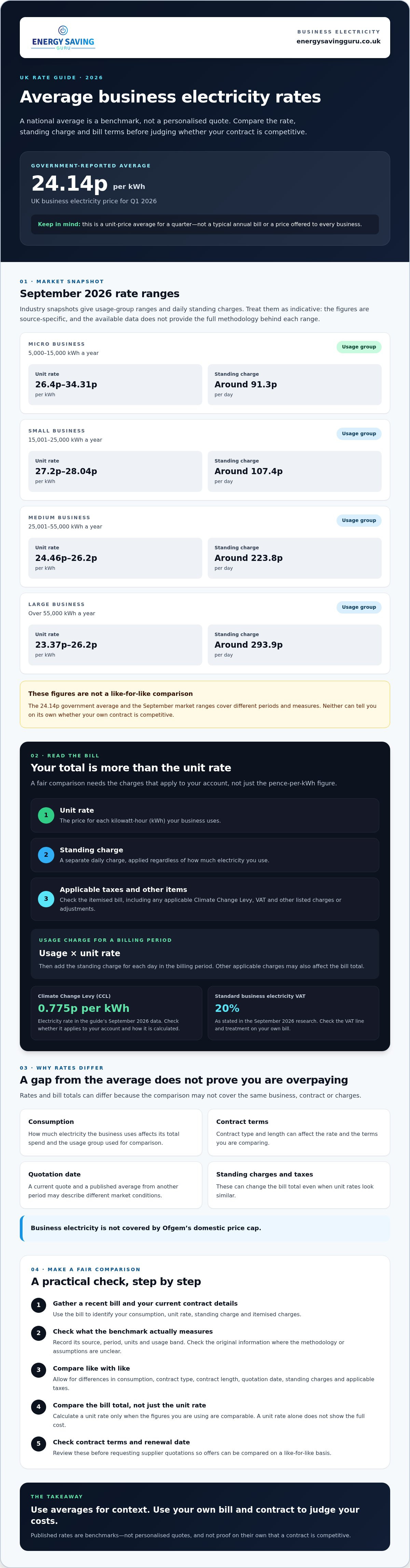
The UK Government reported an average business electricity price of 24.14p per kWh for Q1 2026. This is a unit-price figure for that quarter, not a typical annual bill. The data available for this guide doesn’t specify the dataset’s publication date, detailed methodology or consumption bands. Check those details in the original government release before comparing the figure directly with a supplier quote.
What does an average business electricity rate measure?
A unit rate is the price of each kilowatt-hour used. It isn’t the same as total annual electricity spend, which also depends on how much your business uses and other bill charges. The government’s Q1 figure is a broad average, not a quote for a particular contract or consumption band.
MoneySuperMarket’s figures published on 8 September 2026 and Utility Bidder’s September 2026 data give unit-rate ranges alongside daily standing charges for different usage groups:
- Micro business, 5,000-15,000 kWh a year: about 26.4p-34.31p per kWh, with a standing charge around 91.3p a day.
- Small business, 15,001-25,000 kWh a year: about 27.2p-28.04p per kWh, with a standing charge around 107.4p a day.
- Medium business, 25,001-55,000 kWh a year: about 24.46p-26.2p per kWh, with a standing charge around 223.8p a day.
- Large business, over 55,000 kWh a year: about 23.37p-26.2p per kWh, with a standing charge around 293.9p a day.
These are source-specific September snapshots, not one uniform national average. The available data doesn’t give the full methodology behind each range, so treat them as indicative. Check the original source’s date, contract assumptions and terms before comparing. A wider UK electricity market overview can help explain the system behind energy pricing, but it doesn’t replace current rate data.
Where can you find reliable UK rate data?
Start with official UK statistics for a broad market benchmark. For a closer comparison, use clearly dated industry data and record its source, publication date, units, period and usage band. Don’t compare a quarterly average with a current quote as if they describe the same thing. If a source doesn’t explain what its figure covers, treat it as non-comparable until you can verify the details.
What makes up a business electricity rate and bill?
The unit rate is only one part of the cost. A bill also includes a standing charge and may show taxes, VAT and other applicable items. Comparing only the pence-per-kilowatt-hour figure can make two contracts look more similar than they are.
Unit rate and standing charge: what is the difference?
The unit rate is the price charged for each kilowatt-hour (kWh) of electricity your business uses. Look on your bill for a rate shown in pence per kWh and the meter readings or consumption it covers. The standing charge is a separate daily charge. It applies regardless of how much electricity you use and is usually listed as a daily rate.
Multiply your usage by the unit rate to calculate the usage charge for the billing period. Add the standing charge for each day in that period. Neither figure alone gives you the total cost. Network and other supply costs may also be reflected in the rates or appear as separate lines, depending on your contract and bill layout. The House of Lords Library analysis of electricity prices provides wider context on the factors behind electricity prices in Great Britain.
Which other charges can affect the bill total?
Check the itemised charges on your bill rather than assuming every supplier presents them in the same way. Depending on your circumstances and contract, the total may also include:
- Climate Change Levy (CCL): a tax on business energy use. The current electricity rate in the data used for this guide is 0.775p per kWh, based on AquaSwitch data from September 2026. Check whether it applies to your account and how your supplier has calculated it.
- VAT: the September 2026 research states the standard business electricity VAT rate is 20%. Check the VAT line and its treatment on your own bill. Don’t assume every account or use has identical treatment.
- Other listed items: check any additional charges or adjustments against your contract. Don’t assume an item relates to electricity supply if it covers a separate service.
Illustrative bill layout, with no amounts:
- Electricity used: kWh × unit rate
- Standing charge: daily rate × billing days
- CCL: if applicable
- Other contract or bill adjustments: as listed
- VAT: as shown on the bill
- Total due: the billed amount
Use this layout to check what your bill total includes before comparing it with average business electricity rates. To get help reviewing your business electricity bill and contract details, explore business electricity contract reviews.
Why can your business electricity rate differ from the UK average?
A national average is a starting point, not a verdict on whether your contract offers good value. Your quote reflects details such as annual consumption, meter arrangements, contract type and the date the supplier prices it. A business using electricity steadily across several meters may receive a different offer from one with a different usage pattern.
How do usage and contract details affect quoted rates?
Suppliers assess the information provided when preparing a quote. Consumption determines how much electricity is being priced, while meter setup and usage profile help describe how and where it is used. Contract terms matter too. A fixed-term offer and an out-of-contract rate are different situations, so don’t compare them as if they were equivalent. Prices can also change over time, making the quotation date essential.
| Variable | What to check |
|---|---|
| Consumption | Annual kWh and, where available, how usage varies over time. |
| Contract type | Whether the rate is for a fixed contract or applies when you’re out of contract. |
| Term | Contract length and any terms that affect the quoted offer. |
| Quotation date | When the price was issued. This helps you avoid treating offers from different market dates as if they were current at the same time. |
Location can also affect a supplier’s offer because network costs vary by the area served by the relevant Distribution Network Operator. Credit rating is another factor identified in the data used for this guide. These details may influence a quote, but without comparable supplier data, it isn’t possible to say how much they change a particular business’s rate.
Why doesn’t an average prove your contract is too expensive?
The average business electricity rates you see may refer to a different period, usage group or price measure from the one on your bill. One figure might show a unit rate; another may include a standing charge or describe a different contract basis. Even two unit rates aren’t directly comparable if one comes from an older quotation or reflects a different consumption profile.
Before drawing a conclusion, match the comparison on four points: period, charge definition, contract type and usage basis. Then check the standing charge and other bill items separately. A business whose usage sits well outside the dataset’s band may find the national figure especially unhelpful as a direct comparison.
Treat benchmarking as a prompt to review, not proof that you’re overspending. If the figures don’t line up, gather your recent bill and contract details first. That gives you a clearer basis for asking questions or comparing current supplier quotations.
How can you check your business electricity cost against an average?
Start with a recent bill and your current contract details. The aim is to build a like-for-like comparison, not to force your figures to match a national benchmark. If a key detail is missing, note it rather than filling the gap with an estimate.
Which details should you collect from your electricity bill?
Before comparing, gather the figures and terms that explain what you’re paying for:
- Unit rate: the price per kWh, including any different rates shown for separate periods.
- Standing charge: the daily amount and the number of days covered by the bill.
- Consumption and meter details: the kWh used, meter numbers and whether readings are recorded or estimated.
- Billing period: the dates covered, so you can compare the same length of time.
- Other bill items: note any applicable CCL, VAT and listed adjustments separately.
- Contract information: the current contract type, end date and any renewal or notice details stated in your agreement.
These details show whether the benchmark and your bill use the same charge basis. A unit-rate comparison needs a unit-rate figure. A total-cost comparison needs other charges treated consistently too.
How do you make a fair comparison?
- Choose a verified benchmark. Record its source, publication date, measurement period, usage group and whether it reports a unit rate or another measure.
- Match the period and basis. Compare unit rates with unit rates, and align billing periods and consumption assumptions as closely as possible.
- Check the unit rate. If your bill lists it, use that figure. If you need to calculate it, divide the itemised electricity usage charge by the kWh used. Do this only when both figures cover the same period and the usage charge excludes standing charges, VAT and other items. If charges are bundled or unclear, don’t treat the result as a comparable unit rate.
- Compare total costs separately. Include standing charges, applicable taxes and VAT on both sides, or exclude them from both. Don’t mix a bill total with a benchmark that covers only the unit rate.
- Flag gaps. Mark estimated readings, missing charges or unclear contract terms for checking. Don’t substitute assumed values.
You’re now ready to ask focused questions or request comparable supplier quotations. For help checking your bill and contract details, you can request a business electricity review. A review can help clarify what the figures show, but it doesn’t guarantee a lower rate.
What should you do after checking average business electricity rates?
A benchmark is useful when it gives you a clear question to investigate. If your rate looks different, first check whether the figures cover the same period, usage and charges. A gap alone doesn’t prove your contract is poor value. You may need more detail about your bill or the benchmark before drawing a conclusion.
When is it worth reviewing your business electricity contract?
Review your contract if you’re unsure which rate applies, can’t find the standing charge or don’t understand a bill item. It’s also practical to check the terms and renewal date before your current agreement ends. That gives you time to understand what happens next and request comparable supplier quotations if you choose.
Before making a decision, gather your latest bill and contract. Check the unit rate, standing charge, contract end date and any renewal or notice information stated in the agreement. Compare offers on the same basis, including the contract term and applicable charges. Don’t rely on an average business electricity rate alone to decide whether to switch or renew.
What can a business energy broker help you organise?
A business energy broker can help you review supplier and contract information and keep track of contract and renewal dates. Energy Saving Guru Ltd offers a free, no-obligation utility review. It’s a practical way to examine your details, not a promise of a lower rate or guaranteed savings.
Check how the broker is paid before proceeding. Energy Saving Guru Ltd earns commission from suppliers. That commission may be included in a contract rate or added as an uplift. Ask how any commission or uplift will be disclosed, and make sure you understand the full quoted terms, including unit rate, standing charge, contract length and other applicable charges. You can then assess the complete cost, not just the headline rate.
For support reviewing your business utility contract and renewal details, explore a business utility review. Take the figures at your own pace. A review can help you understand your options, but the right outcome depends on your business needs and the terms available.
Make your next electricity decision with confidence
Before you act, put your latest bill, current contract and any new quotation side by side. Check that each offer covers the same supply details and contract term. This makes it easier to identify anything that needs clarifying before you commit.
A short list of questions can help: what charges are included, when does the contract start, and how will the broker’s supplier commission or any rate uplift be disclosed? Clear answers help you assess the full offer on its terms.
Energy Saving Guru Ltd has operated since 2019 and brings over 25 years of industry experience. It supports businesses across the UK and offers a free, no-obligation utility review. Confirm the review’s current scope before proceeding. It can help you understand your options, but it doesn’t guarantee a lower rate.
To review your business utility details, request a free, no-obligation business utility review. Take the next step when you’re ready, with the information you need to make a considered decision.
Frequently Asked Questions
How much are average business electricity rates in the UK in 2026?
There’s no single rate for every business. UK Government data reports an average of 24.14p per kWh for Q1 2026. September figures from MoneySuperMarket and Utility Bidder show ranges split by annual consumption bands. These are different datasets and periods, so check the source notes before using a figure. Your own quote may differ because it reflects your business and the terms offered at that time.
What is the average business electricity cost per kWh?
The UK Government’s Q1 2026 average was 24.14p per kWh. It describes the price of electricity used, not the complete cost of keeping a business supplied. September 2026 industry figures vary by consumption group. Check the measurement period and usage band before using one as a comparison point. To assess your actual cost, look at your bill’s unit rate separately from its standing charge and other items.
Why is my business electricity rate higher than the average?
Your rate may reflect your annual consumption, meter arrangements, contract type and term, as well as the date the supplier prepared the quote. Network-related costs and credit information can also affect offers. First check whether the benchmark and your rate describe the same charges and usage basis. If they do and a difference remains, review your contract wording and ask your supplier what factors shaped the quoted rate.
Does the average business electricity rate include standing charges?
Check the source definition. A rate stated in pence per kWh usually refers to electricity used and doesn’t automatically include the daily standing charge. Some datasets publish both measures separately. For a fair comparison, keep the unit rate and standing charge distinct, then compare total bills only when both include the same charge categories, billing period and tax treatment. If the source doesn’t explain what’s included, treat the figure cautiously.
How can I calculate my business electricity rate per kWh?
Divide the bill’s itemised electricity usage charge by the kWh used in the same billing period. If the result is in pounds per kWh, multiply by 100 to convert it to pence. Don’t include standing charges, VAT or other items in the usage charge. If your bill bundles costs together or relies on estimated readings, check the supplier’s breakdown before treating your calculation as comparable with a published rate.
Can a business energy broker help me get a lower electricity rate?
A broker can review contract information and help you consider supplier options, but can’t guarantee a lower rate. Energy Saving Guru Ltd offers a free, no-obligation utility review. It receives supplier-paid commission, which may be built into contract rates or added as an uplift. Before proceeding, ask how any commission or uplift will be disclosed and compare the complete contract terms, not just the headline unit rate.
When should I compare business electricity rates before renewal?
Start by checking your agreement for its end date and any renewal or notice terms. Use those dates to plan when to gather bills and request comparable quotations. Suppliers may price offers at different times, so note each quotation date and avoid treating older figures as current. If the contract wording or next steps are unclear, ask your supplier or adviser to explain them before making a renewal or switching decision.
Frequently Asked Questions
A unit rate is the price of each kilowatt-hour used. It isn’t the same as total annual electricity spend, which also depends on how much your business uses and other bill charges. The government’s Q1 figure is a broad average, not a quote for a particular contract or consumption band. MoneySuperMarket’s figures published on 8 September 2026 and Utility Bidder’s September 2026 data give unit-rate ranges alongside daily standing charges for different usage groups: These are source-specific September snapshots, not one uniform national average. The available data doesn’t give the full methodology behind each range, so treat them as indicative. Check the original source’s date, contract assumptions and terms before comparing. A wider UK electricity market overview can help explain the system behind energy pricing, but it doesn’t replace current rate data.
Start with official UK statistics for a broad market benchmark. For a closer comparison, use clearly dated industry data and record its source, publication date, units, period and usage band. Don’t compare a quarterly average with a current quote as if they describe the same thing. If a source doesn’t explain what its figure covers, treat it as non-comparable until you can verify the details. The unit rate is only one part of the cost. A bill also includes a standing charge and may show taxes, VAT and other applicable items. Comparing only the pence-per-kilowatt-hour figure can make two contracts look more similar than they are.
The unit rate is the price charged for each kilowatt-hour (kWh) of electricity your business uses. Look on your bill for a rate shown in pence per kWh and the meter readings or consumption it covers. The standing charge is a separate daily charge. It applies regardless of how much electricity you use and is usually listed as a daily rate. Multiply your usage by the unit rate to calculate the usage charge for the billing period. Add the standing charge for each day in that period. Neither figure alone gives you the total cost. Network and other supply costs may also be reflected in the rates or appear as separate lines, depending on your contract and bill layout. The House of Lords Library analysis of electricity prices provides wider context on the factors behind electricity prices in Great Britain.
Check the itemised charges on your bill rather than assuming every supplier presents them in the same way. Depending on your circumstances and contract, the total may also include: Illustrative bill layout, with no amounts: Use this layout to check what your bill total includes before comparing it with average business electricity rates. To get help reviewing your business electricity bill and contract details, explore business electricity contract reviews. A national average is a starting point, not a verdict on whether your contract offers good value. Your quote reflects details such as annual consumption, meter arrangements, contract type and the date the supplier prices it. A business using electricity steadily across several meters may receive a different offer from one with a different usage pattern.
Suppliers assess the information provided when preparing a quote. Consumption determines how much electricity is being priced, while meter setup and usage profile help describe how and where it is used. Contract terms matter too. A fixed-term offer and an out-of-contract rate are different situations, so don’t compare them as if they were equivalent. Prices can also change over time, making the quotation date essential. Location can also affect a supplier’s offer because network costs vary by the area served by the relevant Distribution Network Operator. Credit rating is another factor identified in the data used for this guide. These details may influence a quote, but without comparable supplier data, it isn’t possible to say how much they change a particular business’s rate.
The average business electricity rates you see may refer to a different period, usage group or price measure from the one on your bill. One figure might show a unit rate; another may include a standing charge or describe a different contract basis. Even two unit rates aren’t directly comparable if one comes from an older quotation or reflects a different consumption profile. Before drawing a conclusion, match the comparison on four points: period, charge definition, contract type and usage basis. Then check the standing charge and other bill items separately. A business whose usage sits well outside the dataset’s band may find the national figure especially unhelpful as a direct comparison. Treat benchmarking as a prompt to review, not proof that you’re overspending. If the figures don’t line up, gather your recent bill and contract details first. That gives you a clearer basis for asking questions or comparing current supplier quotations. Start with a recent bill and your current contract details. The aim is to build a like-for-like comparison, not to force your figures to match a national benchmark. If a key detail is missing, note it rather than filling the gap with an estimate.
Before comparing, gather the figures and terms that explain what you’re paying for: These details show whether the benchmark and your bill use the same charge basis. A unit-rate comparison needs a unit-rate figure. A total-cost comparison needs other charges treated consistently too.
You’re now ready to ask focused questions or request comparable supplier quotations. For help checking your bill and contract details, you can request a business electricity review. A review can help clarify what the figures show, but it doesn’t guarantee a lower rate. A benchmark is useful when it gives you a clear question to investigate. If your rate looks different, first check whether the figures cover the same period, usage and charges. A gap alone doesn’t prove your contract is poor value. You may need more detail about your bill or the benchmark before drawing a conclusion.
Review your contract if you’re unsure which rate applies, can’t find the standing charge or don’t understand a bill item. It’s also practical to check the terms and renewal date before your current agreement ends. That gives you time to understand what happens next and request comparable supplier quotations if you choose. Before making a decision, gather your latest bill and contract. Check the unit rate, standing charge, contract end date and any renewal or notice information stated in the agreement. Compare offers on the same basis, including the contract term and applicable charges. Don’t rely on an average business electricity rate alone to decide whether to switch or renew.
A business energy broker can help you review supplier and contract information and keep track of contract and renewal dates. Energy Saving Guru Ltd offers a free, no-obligation utility review. It’s a practical way to examine your details, not a promise of a lower rate or guaranteed savings. Check how the broker is paid before proceeding. Energy Saving Guru Ltd earns commission from suppliers. That commission may be included in a contract rate or added as an uplift. Ask how any commission or uplift will be disclosed, and make sure you understand the full quoted terms, including unit rate, standing charge, contract length and other applicable charges. You can then assess the complete cost, not just the headline rate. For support reviewing your business utility contract and renewal details, explore a business utility review. Take the figures at your own pace. A review can help you understand your options, but the right outcome depends on your business needs and the terms available. Before you act, put your latest bill, current contract and any new quotation side by side. Check that each offer covers the same supply details and contract term. This makes it easier to identify anything that needs clarifying before you commit. A short list of questions can help: what charges are included, when does the contract start, and how will the broker’s supplier commission or any rate uplift be disclosed? Clear answers help you assess the full offer on its terms. Energy Saving Guru Ltd has operated since 2019 and brings over 25 years of industry experience. It supports businesses across the UK and offers a free, no-obligation utility review. Confirm the review’s current scope before proceeding. It can help you understand your options, but it doesn’t guarantee a lower rate. To review your business utility details, request a free, no-obligation business utility review. Take the next step when you’re ready, with the information you need to make a considered decision.
There’s no single rate for every business. UK Government data reports an average of 24.14p per kWh for Q1 2026. September figures from MoneySuperMarket and Utility Bidder show ranges split by annual consumption bands. These are different datasets and periods, so check the source notes before using a figure. Your own quote may differ because it reflects your business and the terms offered at that time.
The UK Government’s Q1 2026 average was 24.14p per kWh. It describes the price of electricity used, not the complete cost of keeping a business supplied. September 2026 industry figures vary by consumption group. Check the measurement period and usage band before using one as a comparison point. To assess your actual cost, look at your bill’s unit rate separately from its standing charge and other items.
Your rate may reflect your annual consumption, meter arrangements, contract type and term, as well as the date the supplier prepared the quote. Network-related costs and credit information can also affect offers. First check whether the benchmark and your rate describe the same charges and usage basis. If they do and a difference remains, review your contract wording and ask your supplier what factors shaped the quoted rate.
Check the source definition. A rate stated in pence per kWh usually refers to electricity used and doesn’t automatically include the daily standing charge. Some datasets publish both measures separately. For a fair comparison, keep the unit rate and standing charge distinct, then compare total bills only when both include the same charge categories, billing period and tax treatment. If the source doesn’t explain what’s included, treat the figure cautiously.
Divide the bill’s itemised electricity usage charge by the kWh used in the same billing period. If the result is in pounds per kWh, multiply by 100 to convert it to pence. Don’t include standing charges, VAT or other items in the usage charge. If your bill bundles costs together or relies on estimated readings, check the supplier’s breakdown before treating your calculation as comparable with a published rate.
A broker can review contract information and help you consider supplier options, but can’t guarantee a lower rate. Energy Saving Guru Ltd offers a free, no-obligation utility review. It receives supplier-paid commission, which may be built into contract rates or added as an uplift. Before proceeding, ask how any commission or uplift will be disclosed and compare the complete contract terms, not just the headline unit rate.
Start by checking your agreement for its end date and any renewal or notice terms. Use those dates to plan when to gather bills and request comparable quotations. Suppliers may price offers at different times, so note each quotation date and avoid treating older figures as current. If the contract wording or next steps are unclear, ask your supplier or adviser to explain them before making a renewal or switching decision.