
Business Energy Renewals in 2026: Avoid Out-of-Contract Rates
Your business energy renewal is a deadline first and a price comparison second. Business energy renewals can slip down the list when other work takes priority, but missing the end date could leave your business on different, potentially more expensive terms. Unlike households, businesses don’t have an energy price cap to fall back on.
Supplier offers can be hard to compare because the unit rate is only part of the picture. Standing charges, contract length and other terms matter too. Start early: businesses can typically agree a new deal up to 12 months before their current contract ends, while suppliers generally send a renewal letter 60 to 120 days beforehand. Check your own contract for the dates and notice requirements that apply.
This guide explains what to check before your contract ends, when to review your options and how to compare offers on a like-for-like basis. It also covers what to check if your agreement expires before you’ve chosen a new one, so you can make a clear decision without last-minute pressure.
Key Takeaways
- Check your supplier documents for the contract end date, notice requirements and any terms that affect your renewal options.
- Compare business energy renewals using the same usage period, meters and contract requirements for a fairer view of each offer.
- Review unit rates separately from standing charges and other costs listed in the supplier’s documents.
- Gather recent bills, meter details and usage information before asking for renewal offers.
- You can contact your supplier directly or seek broker support with comparing options and tracking renewal dates. Ask how the broker is paid, as supplier commission or rate uplifts may apply.
Business energy renewals: what happens when a contract is ending?
A business energy renewal means reviewing or arranging supply terms before your current agreement ends. It gives you time to check your supplier’s offer and consider other available options before your contract changes or expires. The electricity market in Great Britain has several parts, from generation to the national grid, as outlined in this overview of the electricity market in Great Britain. For your renewal, the key details are the terms that apply to your own supply agreement.
A renewal offer is a proposal for a new agreement. It isn’t necessarily the same as the rates or terms that apply if your existing contract expires without a new deal in place. Suppliers and contracts differ, so don’t assume an offer will roll over automatically or that every business will move onto the same post-contract terms.
Check the exact contract end date, because it tells you when your current terms may change and how much time you have to review your options. Find the date in your agreement or supplier correspondence, then check any notice requirements and what the contract says will happen at expiry.
What are out-of-contract and deemed rates?
“Out-of-contract” usually describes the terms that may apply after an agreed contract ends without a new one being arranged. “Deemed” terms commonly refer to supply without a negotiated contract in place. Suppliers may use these labels differently, and the details depend on your circumstances and agreement. Check your contract and supplier letters for the actual rates, charges and conditions that apply. Don’t rely on a general definition to tell you what your business will pay.
Why can a missed renewal date create extra work?
If the end date passes before you’ve reviewed your options, you may have to compare offers while also finding out which terms now apply. That can put pressure on a decision that is easier to make when you have time to check the details. The practical outcome depends on your contract and supplier, so confirm it rather than assuming.
Start by noting the end date and reading the relevant terms. Then gather the information you’ll need to assess a new offer. Early checks don’t commit you to a supplier. They give you time to ask questions, compare like-for-like and decide what suits your business without unnecessary last-minute pressure.
How business energy renewal dates and contract terms work
There’s no single timetable that applies to every business energy contract. There is no universal renewal window for every business contract, so check your own agreement rather than relying on a general rule. Your contract sets out the relevant dates, notice requirements and options. Suppliers may also send renewal communications before the current agreement ends. Read these carefully, then check the contract to understand what action you need to take and by when.
For an overview of contract types and what may happen when a business agreement ends, see Ofgem’s guidance on business energy contracts. Your supplier’s documents are the place to confirm the terms that apply to your specific supply.
Where to find your business energy renewal date
Start with the signed supply contract. Check recent bills and supplier emails or letters too, as they may refer to the agreement end date or renewal options. If you buy electricity and gas under separate agreements, record each end date separately because they may not match. If a date or notice requirement is unclear, ask your supplier to confirm it in writing and keep the reply with your contract records.
Which contract details should you review?
Before weighing up an offer, check what it covers and how its terms compare with your current agreement. Look for:
- Unit rates and standing charges: Check each charge separately and note which meter or supply it relates to.
- Contract length and payment terms: Make sure you understand how long the offer lasts and how payment is arranged.
- Notice, termination and renewal conditions: Find any stated deadlines or steps you need to follow.
- Meters and supply points: Verify that the offer includes every relevant meter and supply point at your premises.
A quote can look straightforward but leave out a meter or cover a different supply period. Check those details before comparing it with another offer. Keep the contract, bills and supplier correspondence together, then note the confirmed end date and any required action in your diary. This makes renewals easier to manage without relying on a reminder arriving at the right time.
If you’d like support with contract reviews and renewal-date tracking, Energy Saving Guru Ltd provides business energy contract reviews. The review is free and no-obligation. Ask how supplier-paid commission or rate uplifts may apply.
How to compare business energy renewal offers fairly
A headline unit rate can make one offer look better than another, but it won’t show the full picture if the quotes use different assumptions. For a fair comparison, ask suppliers to price the same usage period, meters and contract requirements. Check that each offer covers the same supply points and uses accurate consumption information. If a quote leaves out a meter or relies on an estimate, resolve that before judging the options.
Compare the full written terms, not just the price summary. Ofgem guidance on business energy contracts can help explain contract types and what may happen when an agreement ends. For your own comparison, use the supplier’s documents to identify which charges and conditions apply to each offer.
What to compare beyond the headline unit rate
Set out each offer’s unit rates, standing charges and any other charges shown in the documents as separate items. Add the contract length, payment terms and relevant exit conditions. Confirm that the meter details and consumption figures match your current supply. If a charge, assumption or condition isn’t clear, ask the supplier to explain it in writing before you compare or accept the offer.
A simple comparison table can keep the details side by side. Give each offer a column, then use rows for the unit rate, standing charge, other listed charges, contract duration, payment terms, exit conditions and meters covered. This makes missing information easier to spot. Don’t fill gaps with guesses or assume that charges omitted from one quote are included elsewhere.
What to ask a broker before accepting help
Ask how the broker is paid, and whether supplier commission or a rate uplift may apply. Check which suppliers and contract options they can review, and request a clear explanation of the proposed terms. A broker can help organise a comparison, but shouldn’t be treated as a guarantee of savings. Make sure you understand both the offer and any broker remuneration before deciding.
For business energy renewals, the fairest comparison is one where each offer covers the same requirements and its charges are clear. If an offer can’t be compared on that basis, pause and request the missing details. Clarifying them now can prevent a decision based on an incomplete quote.
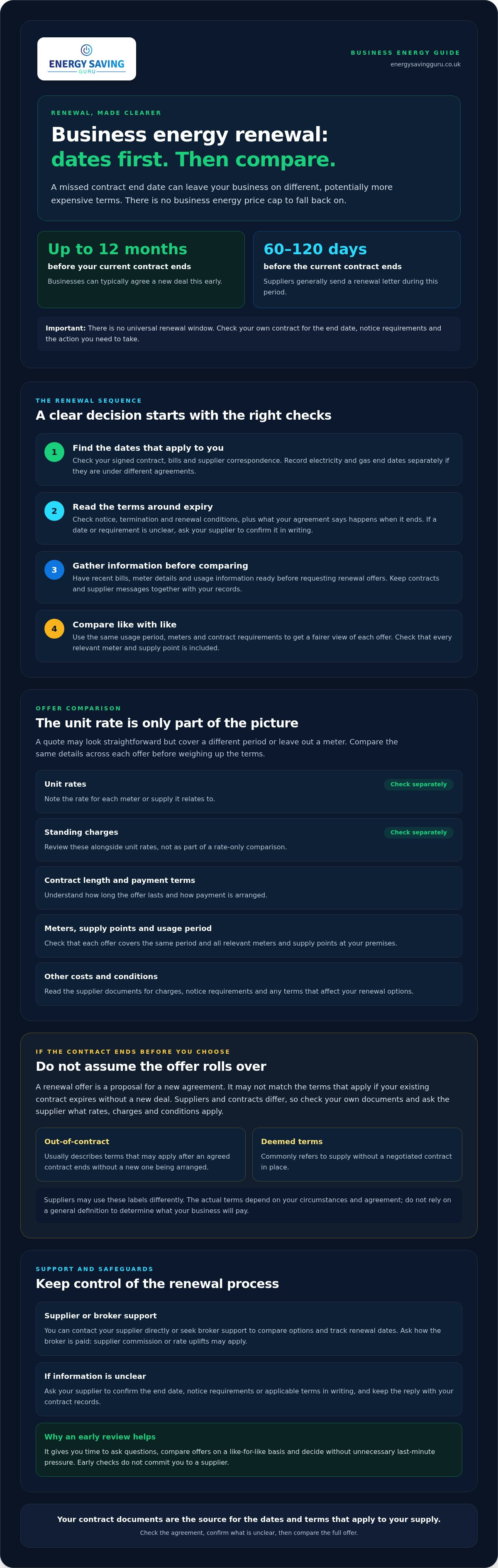
Business energy renewal checklist: before your contract ends
A short checklist makes business energy renewals easier to manage alongside day-to-day tasks. Work through these steps in order and keep the documents together, so you can check details without searching through old emails.
A simple renewal timeline for busy managers
- Confirm the end date. Check the agreement and supplier correspondence. If electricity and gas have separate contracts, record each date separately.
- Read the relevant terms. Note any notice requirements, renewal conditions or other steps set out in each agreement. Ask the supplier to confirm anything unclear in writing.
- Prepare your account details. Gather recent bills, meter identifiers and usage information before asking for offers.
- Request comparable written offers. Make sure each covers the same sites, meters and supply requirements. Keep supplier replies and documents for reference.
- Review before accepting. Check the final rates, charges, contract length, payment terms and conditions against your requirements. Set a reminder to do this before making a decision.
Use the confirmed contract dates to plan your own review schedule. Don’t assume every supplier uses the same renewal process or that a reminder will arrive at a particular point. Your agreement and supplier correspondence are the best guides.
Information to prepare before requesting renewal offers
Have recent bills, meter identifiers and the business account contact details ready. Confirm which sites and meters the renewal should cover, especially if the business operates from more than one premises. Note any expected changes that could affect usage, such as a change in occupancy, operating hours or business activity. This gives suppliers a clearer picture of the requirements behind the quote.
Once offers arrive, keep them alongside your current agreement and bills. Check that each quote includes the same supply points and relevant usage details. If anything is missing or unclear, ask the supplier to explain it in writing rather than comparing on assumptions. Save the answer with the offer so you can refer back to it before accepting.
For support reviewing your business energy contract and keeping renewal dates on track, you can find details of a free, no-obligation energy review. Ask how the review is remunerated, as supplier-paid commission or rate uplifts may apply.
After comparing business energy renewals: choose your next step
Once you’ve reviewed the offers, choose the route that fits your workload. If you have one straightforward contract, handling the renewal directly may be practical. If you’re coordinating several suppliers, meters or end dates, outside support could help keep the process organised. Either way, focus on understanding the offer and making a decision that works for your business, not on promises of savings.
When direct supplier contact may be enough
If you’re comfortable reviewing the options yourself, speak to your supplier and request the full offer in writing. Check the proposed terms and ask for clarification on anything you’re unsure about before accepting. Once you’ve decided, save the supplier’s confirmation and note the outcome with your contract records. That leaves a clear record for whoever manages the account next.
When a business energy broker may help
A broker may be useful if managing several contracts or supply points is taking up time. Ask which suppliers and options they can review, and how they’ll explain the available choices. Confirm how the broker is paid. Supplier commissions or rate uplifts may form part of their remuneration, and a review can’t guarantee savings.
Energy Saving Guru Ltd supports UK businesses with contract reviews, supplier comparisons and renewal-date tracking. Its review is free and no-obligation. Before proceeding, ask how any supplier commission or rate uplift applies to the proposed arrangement.
To explore whether this support suits your business, visit Energy Saving Guru’s business energy review page. You can ask questions first, then decide whether to proceed.
Take control of your next energy renewal
Good business energy renewals start with knowing your contract end date and checking the terms that apply. Compare written offers on the same basis, including usage, meters, standing charges and contract conditions. If the options feel difficult to manage, choose support that fits your business and ask questions before agreeing to anything.
Energy Saving Guru Ltd supports businesses across the UK with energy contract reviews, supplier comparisons and renewal-date tracking. A review can help organise the process, but it doesn’t guarantee savings. The review is free and no-obligation; supplier-paid commission or rate uplifts may apply, so ask how remuneration works before proceeding.
Want a clearer view of your renewal options? Request a free, no-obligation business energy review. With the key dates and terms in hand, you can make your next decision with more confidence and less last-minute pressure.
Frequently Asked Questions
What happens when a business energy contract ends?
When a business energy contract ends, the next arrangement depends on the agreement and the supplier’s terms. You may need to agree a new contract, or different post-contract terms may apply. Don’t assume every account follows the same process. Check your agreement, supplier letters or emails, and bills for the details. If the outcome is unclear, ask the supplier to confirm in writing which terms apply and from when.
When should I start reviewing my business energy renewal?
There’s no single review window that applies to every business contract. Start by checking your agreement for its end date and any notice conditions. Then allow time to collect account details and compare written offers that cover the same requirements. If the wording is unclear, ask your supplier to explain the relevant dates and terms before deciding. Keeping a reminder against the confirmed end date can help business energy renewals stay on your task list.
Are deemed rates the same as out-of-contract rates?
Not necessarily. “Deemed” and “out-of-contract” can describe different supply arrangements, and suppliers may use the terms differently. Don’t assume they mean the same thing or apply in the same way to every business. Check your supply agreement and current supplier information for the exact terms, charges and conditions that would apply to your account after the contract ends. Ask your supplier to clarify any wording you can’t identify.
Can my business switch supplier during a renewal?
Whether and when your business can switch depends on your contract, its notice conditions and the supplier’s process. Check the end date and relevant terms before arranging a move. Ask both your current supplier and the prospective supplier to confirm the required steps and timing in writing. This helps you avoid relying on a general rule that may not fit your agreement, and gives you a clear record of what each supplier has advised.
What should I compare in business energy renewal quotes?
Compare quotes using the same meters and account details. Check unit rates, standing charges, contract length, payment terms and any conditions included in the offer. Confirm that the supplier has used suitable consumption information and that all relevant supply points are covered. Ask for clarification if a charge or assumption isn’t clear. A headline unit rate alone won’t tell you whether two offers have equivalent terms or cover the same requirements.
Do business energy brokers charge a fee for renewal help?
Broker payment arrangements vary, so ask how the broker is remunerated before proceeding. Some receive supplier-paid commission, and payment may be built into contract rates or applied as a rate uplift. Energy Saving Guru’s review is free and no-obligation, but that doesn’t mean the service has no commercial remuneration. Ask whether commission or an uplift applies to the proposed offer and request a clear explanation before you decide.
What information do I need to renew a business energy contract?
Gather recent bills, meter details, your current contract and supplier correspondence. Note the contract end date and check for any notice conditions. Have your business contact details ready, too. It can also help to record expected changes in operating hours, occupancy or energy use, as these may affect the information used to prepare offers. Confirm which sites and meters need to be included so you can compare quotes on a consistent basis.
Frequently Asked Questions
“Out-of-contract” usually describes the terms that may apply after an agreed contract ends without a new one being arranged. “Deemed” terms commonly refer to supply without a negotiated contract in place. Suppliers may use these labels differently, and the details depend on your circumstances and agreement. Check your contract and supplier letters for the actual rates, charges and conditions that apply. Don’t rely on a general definition to tell you what your business will pay.
If the end date passes before you’ve reviewed your options, you may have to compare offers while also finding out which terms now apply. That can put pressure on a decision that is easier to make when you have time to check the details. The practical outcome depends on your contract and supplier, so confirm it rather than assuming. Start by noting the end date and reading the relevant terms. Then gather the information you’ll need to assess a new offer. Early checks don’t commit you to a supplier. They give you time to ask questions, compare like-for-like and decide what suits your business without unnecessary last-minute pressure. There’s no single timetable that applies to every business energy contract. There is no universal renewal window for every business contract, so check your own agreement rather than relying on a general rule. Your contract sets out the relevant dates, notice requirements and options. Suppliers may also send renewal communications before the current agreement ends. Read these carefully, then check the contract to understand what action you need to take and by when. For an overview of contract types and what may happen when a business agreement ends, see Ofgem’s guidance on business energy contracts. Your supplier’s documents are the place to confirm the terms that apply to your specific supply.
Before weighing up an offer, check what it covers and how its terms compare with your current agreement. Look for: A quote can look straightforward but leave out a meter or cover a different supply period. Check those details before comparing it with another offer. Keep the contract, bills and supplier correspondence together, then note the confirmed end date and any required action in your diary. This makes renewals easier to manage without relying on a reminder arriving at the right time. If you’d like support with contract reviews and renewal-date tracking, Energy Saving Guru Ltd provides business energy contract reviews. The review is free and no-obligation. Ask how supplier-paid commission or rate uplifts may apply. A headline unit rate can make one offer look better than another, but it won’t show the full picture if the quotes use different assumptions. For a fair comparison, ask suppliers to price the same usage period, meters and contract requirements. Check that each offer covers the same supply points and uses accurate consumption information. If a quote leaves out a meter or relies on an estimate, resolve that before judging the options. Compare the full written terms, not just the price summary. Ofgem guidance on business energy contracts can help explain contract types and what may happen when an agreement ends. For your own comparison, use the supplier’s documents to identify which charges and conditions apply to each offer.
When a business energy contract ends, the next arrangement depends on the agreement and the supplier’s terms. You may need to agree a new contract, or different post-contract terms may apply. Don’t assume every account follows the same process. Check your agreement, supplier letters or emails, and bills for the details. If the outcome is unclear, ask the supplier to confirm in writing which terms apply and from when.
There’s no single review window that applies to every business contract. Start by checking your agreement for its end date and any notice conditions. Then allow time to collect account details and compare written offers that cover the same requirements. If the wording is unclear, ask your supplier to explain the relevant dates and terms before deciding. Keeping a reminder against the confirmed end date can help business energy renewals stay on your task list.
Not necessarily. “Deemed” and “out-of-contract” can describe different supply arrangements, and suppliers may use the terms differently. Don’t assume they mean the same thing or apply in the same way to every business. Check your supply agreement and current supplier information for the exact terms, charges and conditions that would apply to your account after the contract ends. Ask your supplier to clarify any wording you can’t identify.
Whether and when your business can switch depends on your contract, its notice conditions and the supplier’s process. Check the end date and relevant terms before arranging a move. Ask both your current supplier and the prospective supplier to confirm the required steps and timing in writing. This helps you avoid relying on a general rule that may not fit your agreement, and gives you a clear record of what each supplier has advised.
Compare quotes using the same meters and account details. Check unit rates, standing charges, contract length, payment terms and any conditions included in the offer. Confirm that the supplier has used suitable consumption information and that all relevant supply points are covered. Ask for clarification if a charge or assumption isn’t clear. A headline unit rate alone won’t tell you whether two offers have equivalent terms or cover the same requirements.
Broker payment arrangements vary, so ask how the broker is remunerated before proceeding. Some receive supplier-paid commission, and payment may be built into contract rates or applied as a rate uplift. Energy Saving Guru’s review is free and no-obligation, but that doesn’t mean the service has no commercial remuneration. Ask whether commission or an uplift applies to the proposed offer and request a clear explanation before you decide.
Gather recent bills, meter details, your current contract and supplier correspondence. Note the contract end date and check for any notice conditions. Have your business contact details ready, too. It can also help to record expected changes in operating hours, occupancy or energy use, as these may affect the information used to prepare offers. Confirm which sites and meters need to be included so you can compare quotes on a consistent basis.